 BYKO
BYKOImmutability Removed the Kill Switch. The Bug Stayed.
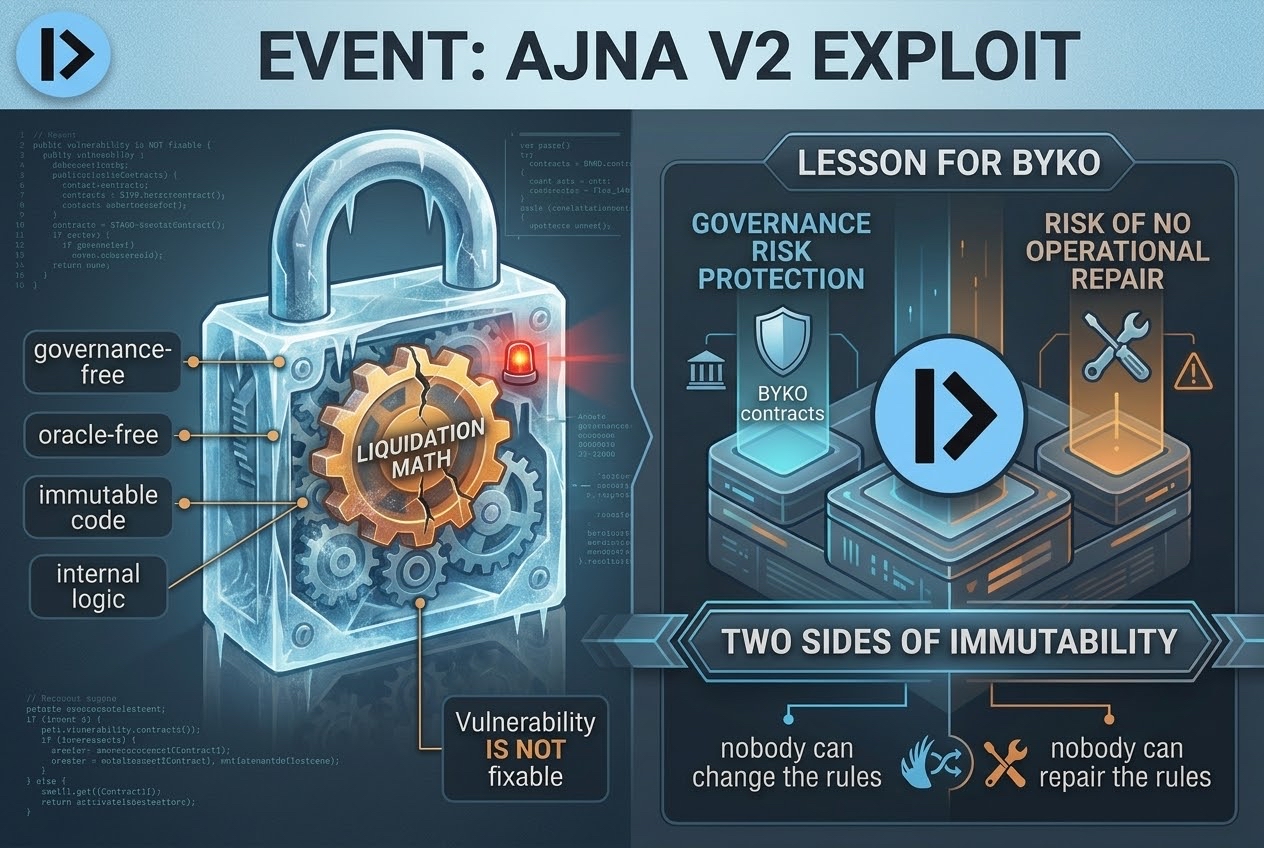
Ajna was designed to remove familiar trust points: no governance, no external price feeds, an immutable protocol.
On August 29, after an exploit affecting multiple lending pools, the team could not simply pause or upgrade the contracts. It asked users to withdraw funds, repay loans and stop interacting. Public estimates put losses around $775K; the exact root cause is still being investigated.
For BYKO, the useful distinction is not "immutability is bad." BYKO deliberately has no owner, mint authority or upgrade path because those powers create their own risks.
The distinction is narrower: removing admin control removes both the ability to abuse that control and the ability to use it in an emergency.
"Nobody can change the rules" and "nobody can repair the rules" are not the same security claim.
A simple fixed-supply ERC-20 is not comparable in complexity to a lending protocol. But the Ajna incident is a useful control case for how BYKO describes itself: contract immutability is evidence about who can change code, not evidence that the code must be correct.
Sources: Ajna, Defimon Alerts, The Crypto Times, Cryptopolitan, Sherlock.
Figures corrected after publication stay on the page: the old number is struck, not deleted, and the entry that fixed it is dated.